Friday, March 20, 2009

6 Tips To Find Followers on Twitter Relevant To Your Business

If you think you have many followers and you follow many matters, then you are wrong. It really does matters, if your followers are ones who have interest in reading what you post and show interest in your Tweets. It is no point in twitting to folks who are not at all interested in your tweets.
  1. The first and the most important thing - do not to spam using your Twitter account. Do not say to your followers, “Just wanted to say hello” and other stuff like this. Do not try to push your product and say “if you buy this you get this free gift”. Twitter is a nice tool for micro-blogging. One has to use the AIDA principle here – Awareness, Interest, Desire and Action.
  2. Use the search option on Twitter to follow like-minded people. Check the profile and their messages and if it interests you or your business, then follow them. Follow those who will feel that they have an advantage from you for following as well.
  3. Apart from just following people with an intention that they may follow you back, your own tweets should stay relevant, to have your follower count grow organically. Just do not follow as many people as you like and forgot about tweeting valuable content.
  4. Also, keep a track if the ones you are following are following you or not. In case they have not followed you for some time, unfollow them and click the follow button again. This will send another email to the person, and you may get another chance to tell them about you. May be, they change their mind now. You have to do this for whom you consider are very important to you for them to follow you.
  5. Share good and quality content pertaining to your industry and business. Not only of your own interest, but you need to consider the interest of the ones who follow you.
  6. If your business has different or varied interest, have different Twitter accounts for each interest. Just the way you use text ads and landing pages in PPC. You setup a different adgroup for each set of keywords pertaining to your business. Like-wise set-up different Twitter accounts and mange the accounts by following and have followers which pertains to the same interest.
There are many more tips and ideas to help you out in increasing the followers, but I feel these are the best ones. I would like you to share your best tips and ideas to increase the Tweet followers which can help in one's business.

Also read: 6 Tips To Use Twitter For Business


twitter means business: how microblogging can help or hurt your company

Sunday, March 15, 2009

6 Tips To Use Twitter For Business

Can this "poor man's email service" help in improving your business? Yes, though it is not as big as other media, Twitter can create that impact with the no. of followers you have to your company handle, and no. of people who are on Twitter and want to know about your company ore related products or services.

Here are few tips to use Twitter for your business.
  1. Tweet to drive people to your company’s website. You can post an update at your company's end and start tweeting about it. You can tweet about the new sucess story or the case study you have published and people may like to read it. Tweet about the case study with a link to that page on your website.
  2. Keep track of you brand on Twitter. Use the search tool, track the people who are tweeting about your brand name or the products. Not only your company, you can search what they are talking about your competitors. You can also set-up a RSS feed for such keywords so that, you receive all this to your RSS reader. This makes your task much easy. If you find anyone who is searching for the products or services which your company offers then let them know about your company.
  3. Use the "Favorites" feature as a list of company testinonials. When you track people you are talking about your company, then favorite all the positive tweets. You just need to click the start symbol which is on the right side, beside the tweet. This particular tweet adds as your favorite. Add all positive feedbacks to your favorites. Use this list of all favorites as testimonials when you want to tweet next time or you can also use it on your website. The link to these favorites will be http://twitter.com/yourhandle/favorites.
  4. Promote your events on Twitter using #. Just like the @handlename, you can use the hashtag for the events, like #event. So, if people want to tweet about the event they will use the same #event and it is easy for you to follow-up. And on your website, you can give the #event tag on the registeration form for people to know about the tweets of this event. For you, it is also easy to know the feedback after the event. You just need to search for #event in the search tool.
  5. Develop relationships with reporters, bloggers and other media people through Twitter. Follow them and keep them updated about the updates at your company's end. Two resources that have a great list of the media people on Twitter are:
    Media Outlets: https://twitteringjournalists.pbwiki.com/Media+Outlets+Using+Twitter
    Media People: https://twitteringjournalists.pbwiki.com/Media+People+Using+Twitter
    http://mediaontwitter.pbwiki.com/
  6. Tweet for customer service. Respond to customer services using twitter. Track any negative comments and resolve the issue immediately and tweet back the response to the customer. This may impress your customer.
Let me if I have missed anything. You can follow me on Twitter - @amalve

Also read: 6 Tips To Find Followers on Twitter Relevant To Your Business

 Twitter Marketing: An Hour a Day

Tuesday, March 10, 2009

Will US Local Ad Market Shrink?

Will the local online takeover traditional local marketing in US? Just have a look at what Kelsey Group and BIA Advisory Services say in their research report.

There is a bad news and the good news about the local advertising.

First with the bad news - The local traditional advertising will be much less in 2013 as compared to 2008. Both the firms predict a compound annual -1.4% overall growth rate, with the largest drop-off in local ad spending occurring in 2009.

The traditional media spend in 2008 is $141 billion and is forecasted to fall to $112 billion in 2013.

Now the good news - The local online ad market is growing, will continue to grow and make up a larger percentage of the local traditional media sector. This year about 11.5% of ad spending for local will be online that means to say yellow pages, emailing, SEM etc. And this will increase to 22% in 2013.

“The share shift we expect (traditional vs digital) could actually be more pronounced if the major traditional media are not able to integrate new interactive products into their bundle,” said Neal Polachek of Kelsey.

(Source: eMarketer.com)

Friday, March 06, 2009

Link Building Helps to Save Money and Build Network

No. This is not the same tips and stories about effective link building. But these are the latest top 10 tips which I feel has evolved and changed as history passed by. I have come up with this post now as, I feel that building links ourselves is far much better than giving it to an agency to do it. So, here the tips that will explain in more detail:
  1. You need to be more interested in links on basis of merit and not their numbers: As you already have your main keyword handy, type the keyword in Google search box and check for the top 3 or 5 sites which are your competitors. For example say www.competitor.com is the website which is ranked #1. Now try to see on which websites this competitor is listed on. Now search for link:www.competitor.com and links:www.competitor.com in Google. You will get a list of sites were this competitor is listed. Analyze the sites and see if they are relevant to your business and check if you can request them to provide you a link. This is tedious but it helps. Be sure that the partner website should not be a link farm else, it will not add any value. Good links are live votes. So be very conscious while selecting link partners.

  2. You can only know what to lay focus on as you know your site specific needs: Once you have the list of websites with whom you can request for links, start submitting your sites to those websites and/or send an email to them. Let the anchor text has your main keyword. Have the description different for the websites as far as possible. See if the website content is in synergy with your website. You know your business very well. So, you are the right judge to identify the websites and the description that has to be used.

  3. Home is not always sweet: It is not necessary that you have to get links only for the home page. But, you can get links for inner pages as well, if you think the content of the inner page has more synergy with the partner website rather than the home page.

  4. Slow and steady wins the race here too: Get only 3 or 4 links per week. Not more. If the link building activities is outsourced then the service provider will only try to get as many links possible in a short span to finish the project. This can be penalized by Google.

  5. Articles do matter: Best way is to write good articles with original content created by you. With a link or two linking to the related information on your website. And submit to websites which take article submissions.

  6. Commenting on Blogs to get the link. Selfish? Subscribe to good blogs which is related to your business. Read the posts on these blogs regularly. Apart from just learning more about your business, you will find an “opportunity” to comment on the posts on these blogs with a link back to your website. Yes. Opportunity in quotes. Don’t go on submitting comments on blogs using the usual dialogue, “I like your post. Also read more about this on my website”. This will not help and will be deleted by the author. Better use a meaning full and real comment and provide your authentic feedback and share your ideas too along with the relevant link to your website.

  7. Participating in Discussions and Forums: Identify good forums and register yourself. Participate in the discussions and make your voice heard. Have a link to your website in the signature.

  8. Answering to questions too helps: Answer questions on social networking websites like LinkedIn, Facebook…etc. You are not only increasing your business network here but you will also learn the questions which the people have pertaining to your interest but, you can also provide a link back to your websites in your answers if it is relevant to do so. You will also open more business avenues through networking.

  9. Ever wondered a tweet can be heard aloud: Yes. Tweet and many people will hear it. Use Twitter.com and have people following you. Put up a status related to your business with a link back. This may not help for building links for Google but will make people visit your website and may help in long run. May be a follower will like your website and will provide a link back to you. You can try FriendFeed as well.

  10. Provide attractive bookmarks to readers to allow them to mark the page if they want to return back later: Returning visitors matter a lot. As in business it goes – To find a new customer takes more effort than getting business from an existing customer. So, provide easy to use and free to use tools to bookmark your websites. Make them easy to use and share sites like Digg, Del.icio.us, StumbleUpon, Technorati, Mixx…etc. Also, use RSS to provide the people know about the updates on your websites.

So, if you do the link building activities yourself, you are not only saving thousands of dollars during this recession period, you are learning more about your business and increasing your network. Who knows after visiting those websites and blogs, you may come up with a novel idea to expand your business. Doing this, you are not only building quality links for your website, but you are building business network and planning for new business strategies for the future which is worth the time-spend.

What More I Want In Google Adwords During This Recession?

I do agree Google Adwords is a powerful tool to get target audience to your website and generate business. But, if you see the present economy and recession, most of the advertisers will like to spend as much less as possible and even if they have to spend on advertising they will be very keen to have the best ROI they ever had. So, the better bet they can see is Adwords or other PPC ads. Content targeting does offers to target the age group and gender but, advertisers need more specific audience.

What does Adwords offer them – targeted audience to a specific location, targeting by placement and targeting by language in addition to the specific keywords they bid on. What I want Adwords to offer much more targeted ads to a more niche segment, which many advertisers may be interested in these times of recession. Apart from the geo specific, I would like to target my ads to a particular profile, title, designation, interests…etc. This way, if I want to target my ads to senior management of banking industry, then I can select this group when configuring my ads. In turn Google can show my ads to that particular audience in particular so that the advertisers get more ROI. They will also not lose on clicks and can write and design landing pages to that specific audience they are targeting for. Thus, helping them with a good CTR, quality score, low CPC and better returns.

In turn, Google will be providing quality ads/searches to that specific audience for which they are looking for.


10 Tips To Increase Online Sales During This Recession

No wonder, why I am telling the same story which everyone know – the slow economy and recession. But, the numbers which I got from eMarketer surprised me.

Unlike in previous years, 2008 was sluggish for B2C sites.

The retail category which has hardly hit were computer software, digital entertainment and office supplies. While fitness equipment, books and magazines did well.


Seeing the above graph, one can interpret that the entertainment, luxury items and office supplies were vastly effected. Under luxury and entertainment we can term – music, videos, jewelry, watches, toys, PDAs and events tickets. So, the buyers have become too cautious in 2008 about what they are spending on. And they have spend the money were they really want to. They just did the purchases for their family needs – health, fitness, books, furniture, flowers and apparels.

What notes you need to take during this time of recession -

  1. Concentrate more on organic search rankings. As it is a free tool to get the target audience and it is the best way when you have tight budgets.
  2. Appropriately allocate the ad and marketing budget.
  3. Have a proper messaging to your campaigns - you are here to fulfill your consumer’s basic needs and not to thrust your product on to them.
  4. Target the niche audience as far as possible. This will help in more conversions and a better ROI.
  5. Do measure your ROI for all your different campaigns separately and regularly. Invest more in the campaigns which is giving you better ROI. Have only ROI-driven strategies and use only quantifiable tactics. If you can’t prove it is working, then slash it.
  6. It requires more effort and time to get a new customer. Better get more business from the existing customer. Concentrate more on customer marketing.
  7. Try cross-selling other products/services to existing customers. This will save time and your customers may want to buy from you rather than other sellers.
  8. If you do not have products/services to cross-sell, then partner with other sellers and scratch each other’s backs.
  9. Increase your affiliate network. Motivate your top affiliates and help them with promotional materials and educate them to get more business during this situation. Better show them these 10-tips :)
  10. Have coupon based or other promotional strategy. Re-look and constantly check, if it working and is it yielding more profits in a shorter span.

This is only the tip of the iceberg. You can get the prospects to your site, but the big question is can you make them buy? I also want to add that this is the best time to increase the market share for your business and beat the competitors before they beat you.

I would appreciate more suggestions from the various thought leaders in this e-Commerce market.

(Source for the above two graphs: eMarketer.com)

Web 2.0 In The Corporate World

Web 2.0 has spread widely among the internet community over the past five years and the social networking sites like Facebook and MySpace boast about more than 100 million users per month. Imagine how easy it is to have a mere 1% of that traffic referred to your site and the sales reaching the peak. These networking tools are more for consumer engagements and interactions. These should not be perceived as sales tools. Corporate companies have already noted the intense strength of these technologies that they are now becoming keen to adopt.

Why corporate are not ready to adopt this latest technology as they have adopted ERP and CRM?
  • Corporate companies are too conservative and the fear of transparency which Web 2.0 offers makes them take the back seat
  • Organizational structure and the lack of knowledge of managers to understand the new trend. Executives feel suspicious and uncomfortable and perceive such changes as taking unwanted risk
  • Unless a quantitative measure is shown these corporate companies will not like to deploy
  • They will not like to discuss about their clients or vice-versa openly and honestly as they feel they have bad competitors
  • Implementation of Web 2.0 does not require much time, but to implement it and to participate in it requires the interaction of the larger workforce

These Web 2.0 tools are easy to implement but inherently disruptive and can challenge an organization and its culture. These interactive tools can be used strategically across the organization internally or externally to tap the unused potential. Corporate leaders should understand that this technology helps their business, employees and of course their customers as this provides a channel for broader collaboration, broader communication, instant and fair solutions to their problems and issues, to get feedback and opinions and helps community building. This in turn will help corporate leaders in generating new ideas and strategies and to take important decisions quickly and wisely.

Thursday, March 05, 2009

The New "Brand" Algorithm of Google

There are all sorts of speculation about the signals Google using to define a site as being a brand will deserve a boost in SERPs. It seems overnight many big brands came up to the first page on Google without any SEO tweaks done to their website. Last month Aaron Wall from SEOBook posted his opinion about the change in the algorithm. The few examples which he has referred are about American Airlines, Delta and North West Airlines have come to the first page of Google for the search keyword ‘airlines tickets’ which was not the case earlier. Even Hallmark.com recently started ranking on first page for the keyword ‘gifts’.

If Aaron is correct then - Is Google giving more credit to the brands? Is it considering that only big brands have original and quality content? Do people look only for brands when they want to search? If I wanted to search for a website of certain brand, I would rather type the brand name as the keyword in Google and directly go to the website. Instead of ‘airlines tickets’, I would rather type ‘Delta airlines’ or American airlines’ and go to their website. I will not rather search for just 'airlines tickets' and check for Delta.

In India SearchMasters 2009 which happened recently in Bangalore, India, Adam Lasnik did mentioned in his Q&A session that, in the title tag, it is always good to use the Company’s name and location where it offers the products and services to be mentioned. I am wondering if he was pointing it to this algorithm change. If we add the company or brand name to the title tag are we not wasting the main real estate here? Adam Lasnik says no. Google considers stuffing of keywords in title tags as spamming. I believe if the brand is well known then it makes a lot of sense to put your brand in the page title or meta description tag. It might help to get clicks and even when it does not at least it helps aid awareness. On top of that, if it builds good CTR then it will help in personalized search.

Another sad news and set-back I see for small players is that they have to build their brand image to beat these brand company’s websites in Google’s result pages. The fact is that it’s just plain hard to define the strength of a local brand using an algorithm or a robot visit.

Few tips to minimize the effect of this change in the algorithm (these are just my guesses now and I have never experimented them). Follow them at your own risks.

  1. Frame your title tag with your company’s name and in short provide the product or service you are offering. If possible mention the local area as well. Example: Company Name: Your product/service description and location. Something like - Northwest Airlines - Airline Tickets, Plane Tickets & Airfare.
  2. Have a short and meaning full description which clearly summarizes the page content/product/service which you have on that page. If description tag is missing and/or is not relevant to the content that is available on that page, Google will take the description for your website which is on DMOZ.org (if at all your website is listed there).
  3. Never use the same title and description tag for all the pages of your website - as usual.
  4. Focus on long-tail keywords as this is more advantageous now. eMarketers.com research showed that more and more people are using long-tail and this will increase in coming months.
  5. Concentrate on local search optimization.

These are just the two cents. And it is too early to suggest any solutions about this change. I am just trying to guess the relationship between what Adam Lasnik talked during the session and this algorithm change.


Latest Important Update: Matt Cutts of Google made a video talking specifically about this change. Matt said, they made a "change" but he wouldn't call it an "update", but rather a "minor change." In fact, in Google they call it the Vince's change. In short, he said this impacts a relatively small number of queries, not the long tail ones and it is more about "trust," the "quality" of the page, the page's "PageRank" and "value" then about brands.

One example he gives at 2m12s) is that if you type in eclipse into Google, the first result is not from Mitsubishi. So he says it is not "brand" focused but more about trust.

Wednesday, March 04, 2009

Google's CEO Terms Twitter As 'poor man's email'

Google CEO Eric Schmidt expects 2009 to be a "tough, tough" year and he warned that the search giant is "not immune" from the worsening economy. "It obviously will affect the online advertising market because our systems are so tightly tuned. If customers are buying less, it will eventually be reflected in CPCs and CPMs," he said.

He talked on a wide variety of topics during an on-stage chat with tech analyst Mary Meeker during the Morgan Stanley Technology Conference held recently in San Francisco. He focused mostly on the economy, calling the current situation "pretty dire" and adding that he doesn't expect it to improve until next year.

Schmidt also said that Google "was pretty inactive right now" on the M&As front, blaming unfavorable prices.

"The good news is we have lots of capital," Schmidt said. "The bad news is we're still trying to get everybody into the model that we really want in terms of M&A. And I think it'll start soon, but it's pretty inactive right now."

When asked about Twitter in a question-and-answer session, Schmidt said Google "was in favor of all these new communications mechanisms. Speaking as a computer scientist, I view all of these as sort of poor man's e-mail systems. They have aspects of an e-mail system, but they do not have a full offering."

It would have been really great and interesting to hear from this search giant’s chief not about the year 2009 but about the year 2015 rather. Everyone now knows that 2009 will be tough.

Moreover, Twitter is much talked about in the internet media and is being used by masses, but the irony is Twitter is yet to find a way to make money. Not only Twitter is poor man’s email system, but still Twitter is poor. More so if Twitter is poor man’s email system, then why has Google signed up for it?

If Twitter has to take Schmidt comments positively and try to develop on those lines, then I guess it will become more powerful. Does it want to be just an instant status informer or a storage based mechanism with more additional or premium features which an e-mail system has? Really do not know what Twitter has in its plan for the future.

Sunday, March 01, 2009

L K Advani a la Obama?

I do not have much interest in writing on politics or giving my opinion on the elections outcome. But, when I came across a banner of Shri LK Advani / BJP on one of the websites when I was browsing, I was intended to click on it and see what is in it. Next, it made me anxious to know his presence in online and social media.

Looking at the past there was no role of marketing or online strategies for the campaigns. And now, the advantages of leveraging social media and internet technology to connect directly with people has not gone unnoticed and the bug has bitten our political parties. The political leaders are trying to ride on the internet technology wave especially to connect with the 100 million first-time voters who would start voting from this general election. But, the way Obama leveraged the social media and networking for online campaign, I guess Advani is trying to follow the same foot-steps (I mean only in online and social networking strategies). I was suprised that the first adopter to this social media is not the young leader Rahul Gandhi or Sachin Pilot, but the 81 years old — Shri. LK Advani.

I have read in a news article that Advani’s team has started with a Web 2.0 and blog, and now his team is leveraging YouTube, Facebook, Orkut and Google Adwords to reach out to the young voter.

However, what remains to be seen is whether he can pull it off the way Obama managed. I just want to have your check on the stats which I got for one of the news article. (Source: RWW)

Facebook: Obama has more than 5.4 million supporters and 570,000 plus wall posts.
YouTube: Obama’s YouTube address garnered nearly a million views.
Twitter: Obama sent out more than 260 Tweets to 144,000 "followers”, updating supporters on his whereabouts.
Other Online tools: The “My Barack Obama” community beautifully used online tools to organize offline activities and generate donations.

In shortl, Obama’s managed to raise $600 million from 3 million people, mainly through small contributions made online.

If we look at the stats of Advani’s team (Source: My own findings. The above numbers can be inaccurate):

Google Adwords: Search on Google for the keywords – Rahul Gandhi, Sonia Gandhi, BJP, TDP, blog, elections, Narendra Modi, Manmohan Singh, Mayawati…may be more. You will see Advani’s ads linking it to his website or his blog. Suprisingly, they are not bidding on ‘Laloo Prasad Yadav’ as the keyword.
Website: His website is buzzing with activity. It has blog, discussion forum having more than 5000 posts, speeches and more. As soon as I went to the page there is welcome note from Advani (You need to have QuickTime plug-in to listen to it. The website does not has mp3 or mp4 audio). It has achieved an impressive Alexa ranking of 13,914 as on yesterday. A Google page rank of 4/10 for the home page. But no page rank yet for inner pages. The visitors traffic to the website is about 400,000 visitors in the last 30 days. Impressive numbers for a website to start with.
Blog: Has well written posts, but infrequent. The last post is dated February 1, 2009. And I see as on date, 122 comments posted here. I did not want to click and read the comments though.
Facebook:Has only 140+ supporters and not much activity happening.
Orkut: He has 531+ as supporters.
YouTube: His channel has 191+ videos and 82+ subscribers as of now.
Twitter: I read on one of the blog that Advani himself does not update the status but his support group does it. The profile used to say so. Ironically, this account was suspended on February 15, 2009 so I can’t provide the number of followers.

Nevertheless, a good beginning and I just imagine that many more Indian politicians engaging online with their voters in the near future. Also, I would love to chat with Laloo Prasad Yadav some time.

My question here is can Advani (or any political leader or party) gain similar support from Indian people who browse the web? Obama won the elections because he is Obama. By walking on the marketing tactics of Obama will not make Advani or anyone else the PM. Of course few net savvy guys may change their mind and vote for Advani, but the question will be how many? Next, Obama used the social networking for Americans. Advani is doing it for Indian audience.

Update on Mar 4, 2009: Oh God! After posting this on LK Advani, my whole blog is carrying his ads and banners. So, do click them and see what BJP has in store for us...

Google Signs Up on Twitter

YES! This is no spam account and Google has very much officially signed up to Twitter – http://twitter.com/Google. I guess Google will use account to post the announcements similar to the Google Official Blog and may be relatively more frequent and quicker than their blog. Matt Cutts of Google himself confirmed that this Google Twitter is real Googler.

The first post was bit confusing and in fact was a binary message.


Later I was able to know that it is – I’m Feeling Lucky.

It more or less signifies that Google agrees Twitter as a form of mass communication in the same way that Google was interested in Blogger. Prior to the launch of Google Official Blog, Google relied on Google Groups and various webmaster forums to communicate with its users, webmasters, publishers and other target audiences for regular updates and issues. And now, Google has a blog for everything. The Official Google Webmaster Central Blog, Official GMail Blog, Google LatLong, Google Analytics Blog, Official Google Enterprise Blog, Offcial Google Mobile Blog and may be more. May be later, they will have Twitter accounts for everything for instant communication and updates.

Here are few Googlers who are already on Twitter - Matt Cutts, John Mueller, Adam Lasnik, Brian White, YouTube, Sarah, Adwords Helper.

Other pertinent Twitters you will love to follow are – Rand Fishkin, Barry Schwartz, Danny Sullivan, Greg Sterling, Matt Mcgee, Vanessa Fox, Elisabeth Osmeloski.

Let me know the missed ones...


Update: Danny from SearchEngineLand provides a exausthistive list of SE/Google/Yahoo/MSN folks on Twitter.

Thursday, February 26, 2009

Tools To Analyze Competitors’ Website Traffic

-->

Here is a list of websites/tools to analyze other websites' traffic and traffic sources. Few of them also provide additional details like traffic trend over a period of time, link popularity... A couple of them provide you details of keywords used in Adwords by your competitors. So, go ahead and use them for SEO and PPC and kill the competitors if you can :). If you don't beat the competition using PPC or SEO then you are giving business to your competitors. So, better know the competitor website's performance and then analyze your online marketing strategy to over shadow them. More over these tools are still free to use.

Alexa.com - Compare traffic and trends of websites up to three websites. Provides Alexa rank, reach and page views of the websites. But, I guess it takes data only from the visitors who have the Alexa toolbar.

Google Trends – use commas to compare unique visitors to multiple sites.

Quantcast – Will be helpful if at all the competitors are “quantified”. Also, you need to register to get the complete report.

Spyfu – One can know the keywords the competitor is bidding on Adwords.

Compete.com – They claim as - Competitive metrics for every site on the web powered by the largest pool of online consumer behavior data in the industry. Here again the competitors need to have considerable traffic for Compete to track it down. Basic numbers are free, but to get more traffic details you need to purchase monthly subscription ranging from $199 to $499 depending on the data you want.

comScore - Is definitely not cheaper and not completely accurate either. I think they use an aggregate data, based on what is available to them.

Hitwise - Hitwise reports offer a concise analysis of market trends in any one of Hitwise's 160+ industry categories or on thousands of categorized websites. Again it is not a free tool. You can contact them with your specific needs and numbers you are looking for and they can very well make a customized report for you. One can try for it in case you have the budget.

Popuri.us - A tool to check at-a-glance the link popularity of any site based on its ranking (Google PageRank, Alexa Rank, Technorati etc.), social bookmarks (del.icio.us, etc), subscribers (Bloglines, etc) and more. This tool may not provide updated results.

MarketLeap – Is a leading provider of integrated digital marketing solutions. They have three different tools to check the link popularity trends, search engine saturation and keyword verification. Of course this can be had manually using Google, but using these tools you can see the trend and compare websites.

Website Grader by HubSpot - Website Grader is a free seo tool that measures the marketing effectiveness of a website. It provides a score that incorporates things like website traffic, SEO, social popularity and other technical factors. It also provides some basic advice on how the website can be improved from a marketing perspective. This can be used as a reference to know how websites have performed over a period of time.

dataopedia.com - Gathering together data from more than 50 sources, dataopedia.com is an aggregation web service that lets its users find out all the valuable facts about any website, such as traffic, online buzz, contact information, popularity in social bookmarking services…in short, all the essential facts about every website you can come across on the internet. dataopedia.com has been conceived as the one-stop-resource for finding website facts.
It's always better to use a composite of all the sites above, to give you a general sense. None of them are completely accurate. dataopedia.com summarizes most of the stats and trends from various sources (compete.com, Alexa..) at one place and it is very easy to see the performance of various sites on one screen/browser.

Let me know if I have missed any good websites here. If so, I will add them as soon as possible so and it will help all of here in the online marketing world.
-->

Monday, February 23, 2009

Admission opens for the TechTarget Online ROI Summit

Know your audience and how to reach them effectively.

In a down economy, this point is more pivotal to marketers than ever before. And, no other event brings you face-to-face with more IT buyers than the TechTarget Online ROI Summit -

Complimentary admission opened last week for the 2009 TechTarget Online ROI Summit on April 14th at the Boston Marriott in Newton, MA - the only event dedicated to helping you reach your IT buyer audience. Apply today at www.techtargetsummit.com

Highlights of this year's Online ROI Summit include...
  • Real-world case studies given by the peers
  • Proven marketing strategies for these hard economic times
  • More senior IT buyers open-panel discussions
  • Best Practices guidelines on converting leads to revenue
  • Latest Google research on search marketing
  • Research and insight into the IT buying process
  • And of course, detailed ROI from real online marketing campaigns

Visit the new Summit website to watch videos of recent panels and catch a glimpse of the new content - www.techtargetsummit.com.

Thursday, February 19, 2009

Google PowerMeter…. “If you cannot measure it, you cannot improve it” – Lord Kelvin

Imagine, you are out of money at the end of the month. What will you do? You will try recall where all and how much you have spent. You will make a note of is it worth that spend or you can try other alternatives. You are just trying to analyze and restrict your expenses.

In a household, if you do not know which electric appliance is taking what measure of the energy then it will be difficult for to reduce the usage and save energy. Without the numbers and analysis you can’t reach to a perfect conclusion. This is where Google wants to chip in to help the people to know which appliances are taking more energy and which are taking less - A good opportunity to save money and fight global warming. The PowerMeter provides the analysis with easy access to energy consumption.

Google PowerMeter, now in prototype, will receive information from utility smart meters and energy management devices and provide anyone who signs up access to her home electricity consumption right on her iGoogle homepage. The graph below shows how someone could use this information to figure out how much energy is used by different household activities.


What a contribution to make the world a better place to live!!

What Google’s Has in Future

Jonathan Rosenberg, SVP of Product Management, Google has recently posted his thinking and the future of Google as well as the internet and the challenges that lie ahead, on Official Google Blog.

I have summarized few things below with my inputs as well (I may have missed few important things). You need to note that, I have added my comments too below and that everything below is not of Rosenberg. You can access his original post on the blog.
  • More internet-enabled phones will be activated in coming years than computers. I guess China and India will be the main markets for this growth as there lay more number of mobile users in these countries. But, the internet bandwidth and the speed which these country offer may hamper the growth.
  • May be in future the computer for the world will be a mobile phone. So, Google sees the mobile area more strategically and profitable.
  • Presently users are searching for the information they need. Google wants to provide the solution to the user before the search is made. So, depending on personalized/customized search, news alerts and RSS subscribed or comments saved, the users will get what they are interested in before a search is made. So, don’t they lose revenue on Adwords? They are smart people; they will have a way out. May be this will have more CPC as it is a WARM lead.
  • More and more user generated content is being created every day mostly by way of blogs. Google will keep a tab on such content and will segregate crap content from authoritative and interesting content written by known or unknown experts. Not sure how they will judge such writers. May be social media spam or content spam will be the next problem for internet. Bullet proofs for posting articles on all the blogs one has? But, I surely think Contnet Marketing and Content Marketing Optimization will be next.
  • People will use computers differently. They will have all their files and data back-up on network cloud. So that, they can access from anywhere with anything – laptop or a mobile phone. They will be going to create more and more competition for Microsoft. This network cloud need to be robust and secure to be successful.

This is just a glimpse of what he has posted there. I do agree with what all Rosenberg talked about and time can prove it. No doubts about this.

What do you think about Google's or Internet future?

Yahoo Introducing Video Ads in Search Advertising

Yahoo is introducing a new type of search advertising that integrates images and video in paid listings, the company plans to announce Thursday.

Search advertising typically shows only text advertisements and links. Marketers usually devote part of their online budget to search — which shows text-only advertisements and links — and part to display, the banner and box advertisements that show images or video.

By introducing video and images, the new offering from Yahoo, called Rich Ads in Search, gives search some of the advantages of banner advertisements. “It moves the advertising experience from just the blue links, to a more engaging experience for advertisers,” said Tim Mayer, the vice president for search monetization and distribution at Yahoo.

Yahoo has been trying to win back paid search advertising from the market leader, Google. Yahoo’s market share in paid search has fallen from 13.8 percent in 2004, to 10.5 percent this year, according to the research firm eMarketer. In the same time period, Google’s market share has more than doubled, from 32.8 percent in 2004, to 67.7 percent this year.

Yahoo’s strength has been its display advertising, where it sells boxes and banners on its highly trafficked pages. However, as the recession has deepened, many advertisers have shifted money to search, which gives them direct, measurable results.

Source: NY Times

Google Analytics To Track Telephone and Live Chat Leads

Google Analytics recently stated in a blog post that they will be integrating a system to track telephone and live chat leads into Google Analytics.

Google has teamed up with Mongoose Metrics to allow users to track the offline calls into the analytics tool. Mongoose Metrics provides toll free number and Google Analytics tracks the calls made to the numbers by assigning that number to a hidden web page on your site containing the analytics tracking script/code.

This is what Jeff Gillis from Google Analytics team has to say – “When a phone call to the tracking number is connected, the technology will place a web browser visit to your hidden tracking web page and in this way insert the phone call event back into your Google Analytics account. Each phone call generates a unique visit which is clearly labeled inside of Analytics”.

As far as tracking of live chat, they have teamed up with Live Person. Live Person created a Google Analytics integration that allows users to track conversions after chat and provide the following data:

  • The Map Overlay Report which provides the volume and quality metrics of live chat interactions by geographic region
  • Provides the sources and keywords that drive interactive chats and thus resulting in conversions
  • The Goal Path Report which lists the navigation flow that led to the chats and so the conversion

Are they still missing any offline tracking of leads or conversions?

Wednesday, February 18, 2009

Corporate Blogs – Why the BIG BUZZ?

There are millions of blogs around and hundreds get launched daily. Currently Technorati tracks over 71 million blogs. More and more corporate are turning to blogosphere to connect with their prospects and customers. It is a good platform for them to listen to their prospects and customers and respond to them. In turn the customers also feel that they are being listened by a person and not auto-responders or IVRs. Blog is an effective access to the frustrations and desires of a company’s target audience.

Corporate and business folks are going towards blogs as:

  • Blog is an effective media for brand awareness
  • Blog is the fastest growing form of consumer generated media
  • Blog can change the way a business interacts with customers
  • Blog can engage your target audience and it is easy here to convert them as customers
  • Blog as an effective media to put before what you have learnt and bring it to action
  • Blog is the most economical way to promote the business – if you do it effectively and strategically
  • You can also market your business through other blogs or asking other bloggers to write about your business and build company’s reputation and address criticism

The few hitches which can the corporate folks can have with a blog are:

  • Finding a good blogger – should also be a part of the decision maker
  • Should balance the sales push and information on the blog to build a loyal readership
  • Negative comments/blogging (on other blogs) can occur and companies need to be ready to tackle such customers/bloggers

There is a very good tool which can be used to track other bloggers which write about your brand, comments being submitted on other blogs or social media websites. This tool is called Trackur. The internet has given a powerful voice to consumers, bloggers, forums and other internet users. You can arm yourself with Trackur's intelligent online reputation monitoring and you'll never get caught by a surprise attack on your good name. The good news is they also have a free trial.

Monday, February 16, 2009

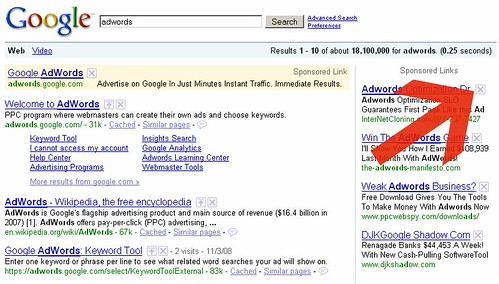
SearchWiki Making Its Way To AdWords?

Yesterday, I saw the Google Adwords ads with a cross (x) mark. So, one can remove the ad if you do not want to see it.

Not sure, if one closes the ad once, then it will not be shown again it is from the same website or advertiser.

Pretty tough...Yet to hear from Google about the update or news.

Sunday, February 15, 2009

Can a small card solve your problem?


Yes, a small plastic card was my most loyal and dependable thing in the journey which solved my major problems.

I just wanted to share this with you all folks... may be this is a bit deviated from the main purpose of the blog. BUT, I just wanted to share how searching on Google solved my problem. Thanks to Google.

The card I am talking about is the calling card purchased online from a UK Calling Cards online shop.

I landed in UK and the main purpose of my travel was to give a surprise to my friends. So, they really do not know that I am already in London. When I landed, to my surprise, I found I was out of money and my debit card has only a balance of 20$.

I just thought that I am pauper now and I did not have anything than open my laptop and browse through. What I did - I went to Google and searched for cheap calling cards. Yes, I used cheap because, you should understand my problem. And I reached a website which has a vast variety of calling cards. More over, I can call from UK.

The solution was using the Google power to find a UK Phone Cards shop to buy them online and make a call to a Amy (my best friend who stays in UK) and ask her to come and pick me up and help me out.

So, to summarize the story - On Google, I typed cheap calling cards, I reached the UK calling cards website - http://www.eurocallingcards.com, I used $11 from my debit card to purchase a good calling card. And I was on the go to talk to Amy.

After talking to Amy, I was surprised that I still had balance on my debit card (of about $9) and also on the calling card. I did not wait longer and I called my family in India and other friends in UK.

So, I learnt - Google and SEO can be your friends and can rescue you in times you are in problems.
>

Friday, February 13, 2009

SEO Job site


Good news to SEO and SEM guys in India. Especially those who want to aspire their career in search engine optimization. There is a dedicated website only to post SEO and SEM related jobs - SEOJOBS.in

This makes me imagine, how far will SEO and SEM will go. I guess this will become the next most wanted skill set, just like software skills. Good to know that India's online marketing is spearing ahead.

Google India Search Masters'09


Glad to inform you that Google will have the Search Masters'09 in their office, at Bangalore on Feb 28. I guess it will have loads of information about the webmasters tools and we will know how to exploit the webmasters tools and resources available there. More over, they have a session on Google's new custom search which I would love to know more about.

If you are in Bangalore don't miss it - SearchMasters'09

SearchCamp 2009


I have been reading the emails of the guys which are working hard and effciently to make this session a great one. These young chaps are enthusiastic and trying all contacts and exploiting all enrgies to make this a succesful one.

SearchCamp is a two day event aimed to bring together the best minds from the Search Engine Marketing space to talk about search engine advertising, including optimization and marketing issues. The event is scheduled for the 28th February & 1st March 2009 at Chennai.

Cheers and best wishes to the team.

Search Engine Marketing 2010

I have a strong feeling that local search optimization will be the real beast which will be more complex and challenging than SEO of a website or a dynamic website. I was just browsing and thought the below few points can be the tips for local search optimization.

So, here are my two cents -

Some tips here can be -

1. To have the keyword in the business name (similar to have keyword in the domain name in SEO)
2. To have a business name which is alphbetically on the top. Ex. to have a business name starting with number(s) 0 or 007 :)
3. To have multiple listings in local areas/cities where one can provide the services (this again is similar to link building)
4. To provide better customer service and request satisfied customers to rate you (I can say PageRank here)
5. In your ads on local search directory, include all the names (or different names the area is known for) of the lane or road your office is located at.
5.

Monday, November 03, 2008

How to reduce Bounce Rate percentage?


First let us be aware of what is Bounce Rate in Google Analytics. Most of the definitions found on the web are bit confusing (as I found them so). Thus, would like to be more clear on what Bounce Rate means.

Bounce rate represent the single-page visitors who bounce out of the website to a different website. Bounce rate is the percentage of initial visitors to the visitors who bounced to other website. In other words, instead of visiting the other pages of the website the visitors close the window, type in other url or click the link of the other website on the page. This is different from Exit Ratio. Exit Ratio is the ratio of all visitors to the visitors who have exit from the website. These visitors can be single-page or multiple-page visitors. Bounce rate only considers single-page visitors.

Now to know why this bounce occurs. If you have a high bounce rate for your website or web pages here are few points which you can ponder upon to make the initial visitors to go into the website.

1. content on the page is not interesting for the visitors,
2. too many external links are available on the page for the visitors to click and go to other website,
3. few links are available on the page to take the visitors the to inner pages (or they are not clearly visible for the visitors),
4. irrelevant visitors coming to the website (not target audience)
5. Page takes too much of time to download - visitors may close the window rather than waiting for the page to download
6. Visitors feel confused after seeing the page

If at all, you want to show external website links on the page/website, do open them in a new window. Just keeping the hope that, the visitor may later visit your website and find it interesting and move into the inner pages.

Thursday, July 31, 2008

SEO Basics For A Rookiee

The Search Engine Optimization process is briefly described by the following stages:

1. Keyword Research:

Proper research assures that your website is optimized around the keywords most often used by your visitors. Without proper research, Optimization is likely to yield poor results. The research phase produces a finalized set of keywords that may be anywhere from 1-150 keywords. You can use the free tool available at http://freekeywords.wordtracker.com. Prepare a set of keywords for every page of the website depending on the content that is on the webpage.

2. Identifying your Competition:

After selecting the best keywords, it is important to know which websites rank highest in the major Search Engines. Websites that appear the most often are referred to as your ‘Competition.' Comparing your website to your Competition helps to give an idea of where the initial efforts of Optimization should be focused. Identify and study the keywords being used. Check the link popularity and PR of the competitors and make a note of it. Identify the traffic the competitors’ are getting. You can use these free tools available at – http://www.marketleap.com, http://www.trafficestimate.com, http://www.alexa.com.

A detailed analysis of your website and the competition provides the details necessary to plan a successful Optimization.

3. Meta Tags: Meta-tags & Title tag, Hyperlinks, Image Alt tags:

Optimizing the HTML code includes creating Title tags, Meta description tags, Meta keyword tags, hyperlinks, and possibly headings & image alt attributes. All of these are factors in helping the search engine spiders to properly classify your site, with some being more important than others. Rather than go into detail on how to perform all of these tasks, I'll direct you to some of my previous SEO articles.

When your code is optimized, it's finally time to upload your new pages to your server. In the past, at this point we would then resubmit them to the search engines. However, these days, this is an unnecessary step. As long as you're dealing with an existing site with some links already pointing to it, the search spiders should visit and index at least your home page fairly quickly. It may take a bit longer for them to re-index the inner pages, but you can rest assured that they will.

Do not spam the description or keyword meta tag by stuffing meaningless keywords or even spend too much time on this tag. SEO pros all agree that these tags are not as important today as they once were.

4. Content Optimization:

Once the keyword phrases are chosen for each page of the site, it's time to get down to the nitty-gritty and start utilizing them within the copy. If you're rewriting from scratch, be sure your copywriter understands which phrases need to be used, what the goals of the site are, and who the target market is. Obviously this information will affect how they write the copy, so the more they know; the more accurate your copy will turn out. If you're lucky enough to be able to work in the necessary keywords, that's your next step. Once your copy is finished and approved, you should now have a number of pages focusing on 2 or 3 keyword phrases each.

5. HTML Site Map:

Create the html sitemaps providing the links of all the pages. Have the keywords in the body text and the anchor links if possible.

6. XML Site Map:

Create xml sitemaps and submit to Google and Yahoo. Free tools are available on - http://www.xml-sitemaps.com/, www.google.com/webmasters/ and http://siteexplorer.search.yahoo.com/.

7. Website Structure Analysis:

Website Structure Analysis actually means website architecture. It is an approach to the design and planning of websites which involves certain criteria like technical, aesthetic and functional. The main focus is on the user and user requirements in designing a structure of the website. Attention is primarily given to the web content, usability, interaction design, information and web design.

In case of search engine optimization the navigation schemes of the website should be created most importantly for use by visitors. Through usability testing we can easily determine what type of navigation schemes visitors prefer. Like for example a text based or graphics based one.

For a website to be successful first and foremost, it should satisfy your target audience. At the same time by making sites simple and easily accessible we will be providing the easiest path for the search engine robots to index our site. This strategy helps in the long run success of search engine optimization. No matter how often the search engines algorithm change the good content and simple navigation is always rewarded.

Search engine friendly design: The easier the navigation and the more text on the page the better it is not only for the visitor but also for the search engine robots. Certain points to be considered while designing a search engine friendly site are not to include long javascript in the source code, dynamically generated pages, frames and so on as the search engine robots have difficulty in crawling them.

However there are techniques to overcome the problems with indexing but the best way to assure that the pages will be indexed is to keep them simple and ensure return visits both from the search engines and the visitors as well.

8. Robot.txt file:

Many search engines use programs called robots to gather web pages for indexing. These programs are not limited to a pre-defined list of web pages; they can follow links on pages they find, which makes them a form of intelligent agent. The process of following links is called spidering, wandering, or gathering.

The robots.txt file,

• is a text file created in notepad or any text editor
• should be placed in the top level directory or root of the website or server space
• should include all lower case letters

Through the robots.txt file we can,

• exclude all robots from visiting the server
• allow complete access to all robots
• exclude robots from accessing a portion of the server
• exclude a specific robot
• exclude certain type of files from accessing by specifying the file extensions.

Here are few examples of robot.txt file. Check both good and bad practices.

Entry Meaning
User-agent: *
Disallow:
The asterisk (*) in the User-agent field is shorthand for "all robots". Because nothing is disallowed, everything is allowed.
User-agent: *
Disallow: /cgi-bin/
Disallow: /tmp/
Disallow: /private/

In this example, all robots can visit every directory except the three mentioned.

More examples are available in my previous post - http://seocolumn.blogspot.com/2005/12/search-engine-robots-and-robottxt.html

9. One-way links and Directory links:

Some SEOs recommend that you do these before all the other work so that you can start getting rankings right away. However, I prefer to wait until the copy changes have been made and uploaded. The newly focused copy helps the directory reviewers to more easily understand what your site is all about, and they'll be less apt to edit your submitted description. If you submit before your site's copy is using your specific keyword phrases within the copy, the reviewer may feel these keywords don't belong within your directory description.

When link building, think quality, not quantity. One single, good, authoritative link can do a lot more for you than a dozen poor quality links, which can actually hurt you.

Where as directory submission to Yahoo, DMOZ… can happen immediately. You just need to make sure you have the details asked by these website forms are ready with you. And make sure to have the home page to have some relevant content prior to submission to these directories.

10. Reciprocal links:

As with directory submissions, I prefer to wait until the site is in perfect condition before starting to request links. You can certainly get started researching link partners before the SEO is complete; however, the better your site is, the more likely others will be willing to link to it. Link building can be done in a quick burst, but should also be an ongoing process. You should always be on the lookout for sites that are a good fit with yours and contact them about exchanging links.

In some cases, additional content pages may also need to be created as per the need of the keywords you want to rank for.

11. Article Submissions:

The fundamental base of the internet is not the page, but the link. A great way to accumulate links is to write articles and submit them to places interested in quality articles.

When you write articles for free on certain websites, you are typically given a by-line or author bio which you can link to your website. Few websites also accept links within the body text using html tags.

Few good Article resources are listed below.

http://goarticles.com/
http://ezinearticles.com/add_url.html
http://amazines.com
http://www.articlecity.com/
http://bpubs.com/
http://businessknowhow.com/
http://www.certificate.net/wwio/ideas.shtml
http://www.promotionworld.com/
http://promotenewz.com/

12. Adopt Web 2.0 Technologies:

Do not think that the traditional tactics of SEO – optimizing using meta tags, keyword density, prominence of keywords…more has lost the importance. They are still important and one needs to follow these for better rankings.

Here are few easy steps…http://seocolumn.blogspot.com/search/label/web 2.0

Guidelines for content writing to improve ranking in search engines

This is only for front-end content writing...

Keyword Relevancy: The more relevant the content is to a specific search term, the more likely the page will rank at the top of search results for that search query. Each page need to be targeted to a keyword / key phrase rather than all the pages for all the keywords.

Keyword Density: There is an optimal ratio of key terms to the overall amount of text that must be used for search engine optimization purposes. Keyword Density refers to the overall density of a given keyword for a particular page and is extremely, extremely important for SEO strategy.

Header Tags: This is a combination of the words found in the title, the headings on the web page and the body of the text. Each page need to have the keyword in the header tag and title tag.

Keyword Prominence: Let the header tag and/or the first word of the first line start with the keywords. Also, have the keyword in the every first line of each paragraph (the keyword needs to be in first 90 characters). The same goes for closing the content - have the keyword phrase twice in the closing paragraph as well as in the last 90 characters.

Anchor Text / Links: Link the key phrases to the appropriate pages. Even here - do not try to link all the main keywords to all the pages. Identify a key phrase for each page and link it. Treat every web page as a different website.

Tuesday, July 29, 2008

SEO of Dynamic Pages

Here are some things to keep in mind when optimizing dynamic pages:
  1. Dynamic URLs are definitely search engine friendly.
  2. If possible specify the title tag. Or use a CMS which has this option. Title tag is the most important on-page SEO factor. Most CMS's use the site name as the default title tag. The worst ones use it as the title for all pages, less worse ones use it in the form " ". Ideally, you want the page title first. And make sure that the title of that content page is well optimized for the keywords you're trying to target.
  3. Specify meta tags. This is not so important for SEO, but can make a difference to your click-throughs from the SERPs (search engine results pages) - particularly the meta description. Ideally, you can specify the content for the meta description when you're creating content. Same goes for the meta keywords, but this is very minor. Major search engines don't really care anymore.
  4. Proper use of heading tags. Make sure that you use h1 tag for the page heading, and use subheadings (h2 tag, etc) for sub-headers in the content. These are relatively well weighted SEO factors. If you're using a WYSIWYG editor in the CMS, make sure that it uses tags as opposed to just changing the font size.
  5. Clean code. I've seen so many dynamic sites that are messily coded. Ideally, the outputted HTML code is as clean as possible and the actual content appears relatively close to the top of the HTML. Using CSS-based, non-table layouts will make a difference here as well.
  6. With regards to listing all the dynamic links on a static page, that's not really necessary, though it's a still a good idea to have a sitemap - both HTML and XML.

Tuesday, September 11, 2007

Optimizing for Search Engines in particular country

Easy and simple way to optimize website for Google / Yahoo / Bing for a particular country - google.co.uk or yahoo.co.us.
  1. The top-level domain (site.co.uk) needs to be from that country. Ex. To optimize for google.co.uk have .co.uk as extension for the domain name.
  2. Host the website in the country to which geo search engine you want to optimize for. Ex. If the website is to be optimized for google.co.uk or yahoo.co.uk then have the hosting server in UK. Spiders consider the server IP to rank the websites in the geo targetted SE.
  3. Know the number of backlinks you have from particular country or geogrphical area. The website needs to have enough number of backlinks from the websites of that geo area or hosted in the geo area. Ex. Easy way to swap links for UK is to have enough number of links from .co.uk domain extensions. A good free tool is available at Ekstreme.com. It shows the number of backlinks the website has from each country website.
  4. Try posting the website in local directories and classifieds.
  5. Have the local phone number and address in the footer of the website and contact us page.

Sunday, August 12, 2007

Easy Way to Adopt Web 2.0 Technologies for Better SEO

Heard and read lot about the Web 2.0 technologies and are just wondering how to adopt for better search engine rankings. Here are the easy steps…

  1. Do not think that the traditional tactics of SEO – optimizing using meta tags, keyword density, prominence of keywords…more has lost the importance. They are still important and one needs to follow these for better rankings.
  2. Have a good CSS for the web pages. Usage of header tags is very important. Use the main keywords in the header tags.
  3. Instead of using java scripts on the web pages use Ajax. Ajax is the best way to display more content on pages. The web page does not look stuffy but gets a professional look. Get the content preloaded in the html via CSS.
  4. Content is KING. But not webmasters but the content written by the visitors. Add blog and discussion board on the website. Educate people of new things through the blog and listen to the visitors through the discussion boards.
  5. Do visit wiki and read what is there and provide your feedback and suggestions. You need to be more clever about how to do this.
  6. Have a short video / audio file on the website. Thanks to YouTube.
  7. Use ALT tags for the images. Do not repeat the same ALT tag description for all images. Use the proper keywords for ALT tags.
  8. Have press releases and articles sections on the website. Provide and submit them to newswires. Have RSS, Del.icio.us, DIGG, Technorati Reddit for the visitors to bookmark the sites.
  9. Use Google widgets for showing driving directions (Google maps), time converters. You have bunch of them on Google. Use which ever you feel is best for your website.

7 Steps To Make A Newsletter As A Tool For More Conversions

Here are the 7 Steps to make email campaigns or newsletters a tool to have more conversions - apart from the regular tips like send to who have subscribed for, provide unsubscribe link and provide a link to view in html, use less images....
  1. The subject line is the MOST important for an email campaign to be successful. Need to have a punchy line - Special Offer..., Invitation for ... - try avoid using the words free and $ in the subject line. You need to avoid ending up in the junk folder.
  2. The best way to know how an email campaign has worked is offer a specific promo code for the readers. You will surely know the no. of opens, clicks. But, to know how many have purchased is through the promo code. Just check - how may have made a purchase using the promo code in the store.
  3. The best media to promote our business is through a customer. If customer tells good about us let people know. Have a customer testimonial of a satisfied customer.
  4. New customers want to know the level of after-sales-service. Have a support phone no. or email in the newsletter.
  5. Make the newsletter interesting. Have a quiz or a survey to know what customer is thinking about you and this is the best to know what needs to done to improve the customer service.
  6. Inform the customer that the shopping process is fast, easy and secure in 3 easy steps – select the product(s), provide billing/shipping address and give credit card details.
  7. Last but not least – have the email campaign on Wednesdays. Wednesday is the best day to send out newsletters as research says it is effective and the no. of opens will be more on this day. YES – On Monday and Tuesday most of the readers are busy and they come back after weekend and they hardly want to spend time on reading it. More chances are that the newsletter will go to the trash folder. On Thursday and Friday people tend to prepare for the long weekend. So, we are left only with Wednesday.

Thursday, May 17, 2007

Conversion Rate Optimization Part 1, Google Takes the Leading Role

Within the e-commerce sphere, the "mind games" between site owners and search engine designers have focused on search engine optimization (SEO). After all, you can't make a sale if visitors aren't reaching your site. However, as the web marketplace grows exponentially more competitive, attention among webmasters and site owners has turned to conversion optimization — converting site visitors to buyers.

Conversion optimization has nothing to do with SEO. SEO is designed for spiders and bots. Conversion optimization is based on two factors only: the needs and motivations of human site visitors and persuasive site content and design to encourage humans to make a purchase or perform some other action. Any other considerations are sub-sets of these two factors in conversion optimization strategies.

Measuring Human Motivations and Site Effectiveness

SEO is based on the development of numbers (metrics) that are immutable. Numbers are numbers, there's no debating that. The interpretation of site metrics, on the other hand, is a true combination of art, science and testing.

Assessing conversion rate optimization must apply a completely different approach to data gathering and the accurate, actionable assessment of the cold hard facts (percentages and such) that are the basis of SEO.

Measuring Human Motivations and Site Effectiveness

SEO is based on the development of numbers (metrics) that are immutable. Numbers are numbers, there's no debating that. The interpretation of site metrics, on the other hand, is a true combination of art, science and testing.

Assessing conversion rate optimization must apply a completely different approach to data gathering and the accurate, actionable assessment of the cold hard facts (percentages and such) that are the basis of SEO.

The Google Website Optimizer (GWO)

Google owns SEO (sorry Yahoo). It is now moving into eyeball optimization (EBO) to help site owners improve conversion rates. It's got lots of features, it's totally flexible in designing useful tests for human reactions and it provides data using simple to read and understand charts showing what's working and what would work even better.

One key point here: after indexing billions and billions of web pages, who is going to know better what works and doesn't work for solid EBO? After all, all the Google gurus have to do is evaluate their top performing sites to develop measurement criteria and tools to improve conversion optimization. Google is going to know what works.

One other point worth mentioning — it's frëe. A flexible, user-designed test engine developed by Google and available frëe. It's a must have for any site owner, site designer, webmaster or SEO.

What Can Google Website Optimizer Do For Me & How Can It Do It If I Don't Know the Difference Between a Statistical Mean and a Statistical Average?

Multi-Variable Testing

Got to have it. When quantifying human motivations and the effectiveness of a site page, you must have data to compare - data based on site variables such as a different home page image or revised site text. There are hundreds of variables within any website. Color selections, type font, type color, navigation tools, product images and descriptions — literally an endless líst of variables.

Google's Website Optimizer allows you to design tests to compare variables to see which ones work best. Often called A/B split tests, these simply compare a change or two to see which performs best. For example, you might have a picture of your product on test site A and a photo of the product in use by a human on test site B. Simply by comparing visitors' reactions to pages A and B, you can make refinements to your site.

Another useful A/B split test to chëck the success of your Adwords placements is to create two identical ads with two different destination URLs. You'll quickly discover which placements pay for themselves and which should be dropped.

Easy Analytics

The information gathered by Google during testing is delivered in an easy-to-understand format. You'll see, in graphic förm, where visitors go and where they don't go when on site. Taking a good hard look at your bounce rates and possible paths-thru-site are essential parts of your ongoing conversion optimization diet.

Usability Testing

Real humans navigating your site. Get as many people as you can to site down and clíck around - from your computer-whiz 12-year-old to mom and dad who still use dial-up. These tests provide the reasons why visitors take specific actions — over and over again.

Eyeball Optimization

GWO shows you what attracts eyeballs but doesn't generate a clíck. It also shows what visitors miss entirely because it's misplaced or mislabeled. Every page should undergo an "EBO" to improve conversion rates.

Follow the Leaders

You can't copyright an idea so use the same features and techniques employed by higher ranking competitor sites. Then, conduct A/B split tests to see which changes show improvement in conversion optimization.

People Are Still the Same

There's nothing new about direct response advertising, which is what successful sites use. Infomercials, newspaper ads, TV 30-second spots — these are all examples of direct response advertising and the same motivators that work in other media will also work on your website. Once again, you can't copyright an idea and the principles of direct response marketing haven't changed one iota.

Determine and identify the buyer's needs; provide the solution to meet those needs. It's worked for the past few millennia and it'll work for you today.

Small Steps or One Giant Leap

Do you make incremental improvements or try to fix everything all at once. It depends on where you are right now. If you've optimized your site (or paid to have it optimized) a small step here and there can make a huge difference, and a major revamping of your site may actually set you back in the optimization race.

On the other hand, if you're just launching, run a couple of A/B splits and other analytics to see which site pages are hot and which are not. Adjust accordingly. The point here? The more optimized the site, the less optimization is needed so if you've been at it for a while, take small steps and assess improvements. If you're just starting out, launch, track and adjust as needed — whether it be small steps or the proverbial giant leap.

Create a Diagram of Your Marketing Funnel

Start with placed adverts (Adwords, paid links, etc.) Add your home page, each product page, the checkout, automated order conformation, customer care and order fulfillment. Each one of these is a component of a sale and, from the líst and with the help of GWO, you'll be able to more clearly identify holes in your marketing funnel — those areas most in need of improvement, i.e., optimization.

Now, this is just the beginning. Conversion optimization is an on-going process and there are additional steps you can take based on test results delivered by Google's Web Optimizer - steps that we'll look at more closely in part 2 of this series.

Author - Frederick Townes, CEO of W3 EDGE

Online Marketing Tips

Internet Marketing isn't complex or new. Yet we see the same mistakes being made over and over by the marketing executives, sales professionals and owners of small or new businesses.

Small business owners sometimes lament over the fact that they don't have a million-dollar marketing budget. While we've all thought about how much easier things would be if we had unlimited funds, it's still possible to earn a decent profit with the right marketing plan,
product and service.

Thousands of small to medium size business owners can attest to their success at building a profitable business on a 'shoestring' budget. However, making a few mistakes can just as easily lose you a nice chunk of cash.

If done correctly, Internet Marketing is a very effective medium to generate new leads, and build continuous contact with your prospects. It can easily help you yield new sales and exceed your targets.

Many entrepreneurs think that selling to the widest possible market is the likeliest path to success. They are afraid to pursue a niche market because they fear they'll lose business by turning away prospects.

But this 'take all comers' approach is not very effective. It's hard to stand out when you market your business without a distinctive set of prospects in mind. Occupying a niche market means you won't be competing with a lot of similar businesses solely on price.

And because you will be selling products and services that are customized to the specific needs and predispositions of a select group of people, you can often charge more.

Your products and services should serve a market that can't easily find alternatives whether it be the product or services itself, the price or most importantly, good customer service.

When providing my services as an Internet Marketing Consultant to businesses, I often ask these questions:

1. Who are your prospects?
2. Who will buy your product?

I am often surprised that business people either have no idea who will buy from them, or they assume that 'everyone' will. Assumptions like this can lead to wrong decisions, wrong pricing, wrong marketing strategy - and ultimately, business failure.

The most successful businesses understand that only a limited number of people will buy their product or service. The task then becomes determining, as closely as possible, exactly who those people are, and 'targeting' the business's marketing efforts and money toward them. You too, can build a better, stronger and successful Internet Web Services and Online Marketing business, by identifying and serving a particular prospect group - your target market.

One of the first things you need to do is to refine your product or service so that you are NOT trying to be 'all things' to all people - Become a specialist!

Take Care Of These Steps And You Are On Your Way To A Successful Business!